20 May, 2026
"Mechanistic control of stick-slip instability in fragile thin-film energy devices"
Xiaole Li, Ahmed A. Said, Farrukh Kamoliddinov, Helen Bristow, Mohammed Bahabri, Saichao Dang, Arsalan Razzaq, Sigurdur T. Thoroddsen, Stefaan De Wolf, and Gilles Lubineau
NEWTON (Cell Press) (2026)
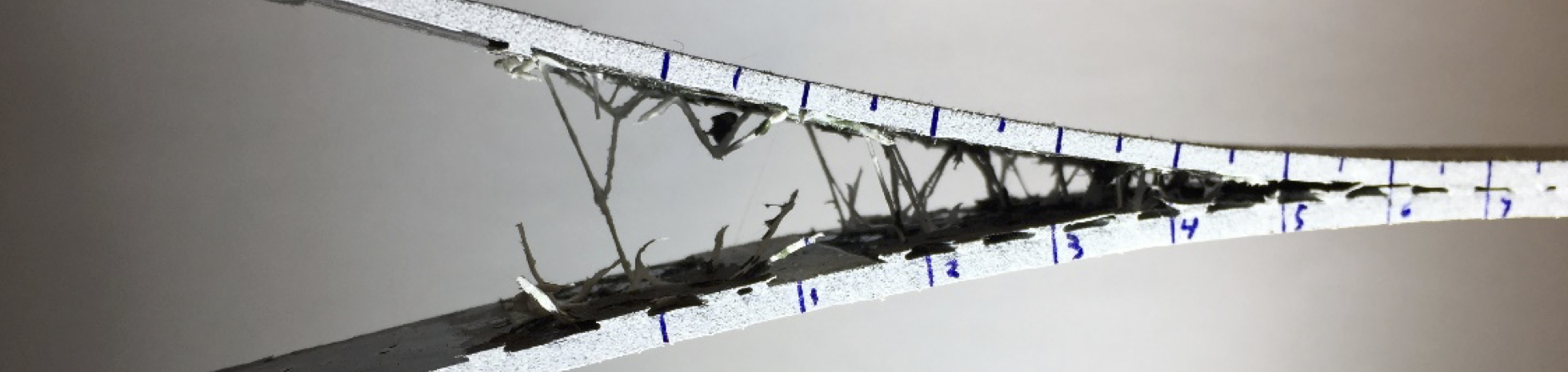
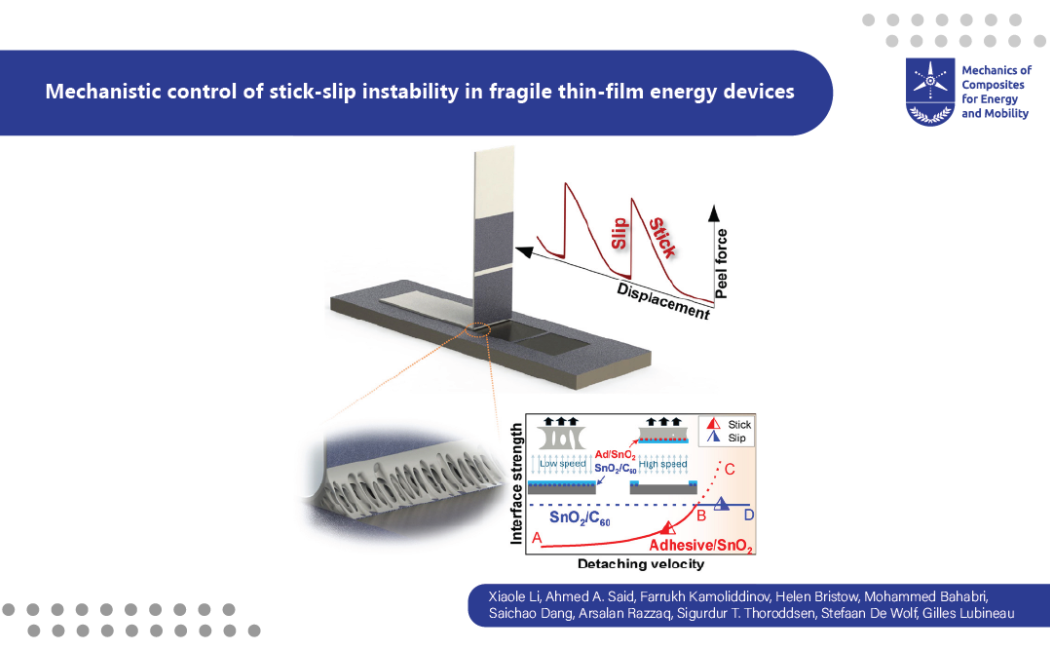
Mechanical reliability is a persistent bottleneck for fragile thin-film technologies, ranging from flexible electronics to next-generation perovskite photovoltaics. While the peeling response should ideally serve as a sensitive probe of interfacial mechanics, measurements are frequently obscured by stick-slip instability, which produces erratic force traces and unreliable data. This study identifies the mechanistic origin of stick-slip instability during tape peeling as a dynamic transition between strength-governed initiation and energy-governed propagation, driven by the viscoelasticity of adhesive fibrillation. In complex multilayer architectures, this instability is intensified by fracture-pathway competition, where the crack front dynamically migrates between competing interfaces. This explains why stick-slips occur even at low peeling velocities previously regarded as stable. Guided by these insights, we introduce a robust experimental protocol using thermoplastic polyurethane films to suppress fibrillation and constrain the intended fracture path. This approach enables reproducible adhesion measurements across diverse architectures and reveals how residual stress in transparent conductive oxides undermines the mechanical integrity of perovskite solar modules. Beyond photovoltaics, these findings provide a standardized framework for quantifying interfacial integrity in advanced, mechanically heterogeneous thin-film systems.
Mechanistic control of stick-slip instability in fragile thin-film energy devices: Newton