18 May, 2026
"Mechanistic control of stick-slip instability in fragile thin-film energy devices"
Ahmed Wagih, Karim Chouchen, Fatih E. Oz, Xiaole Li, and Gilles Lubineau
International Journal of Hydrogen Energy (2026)
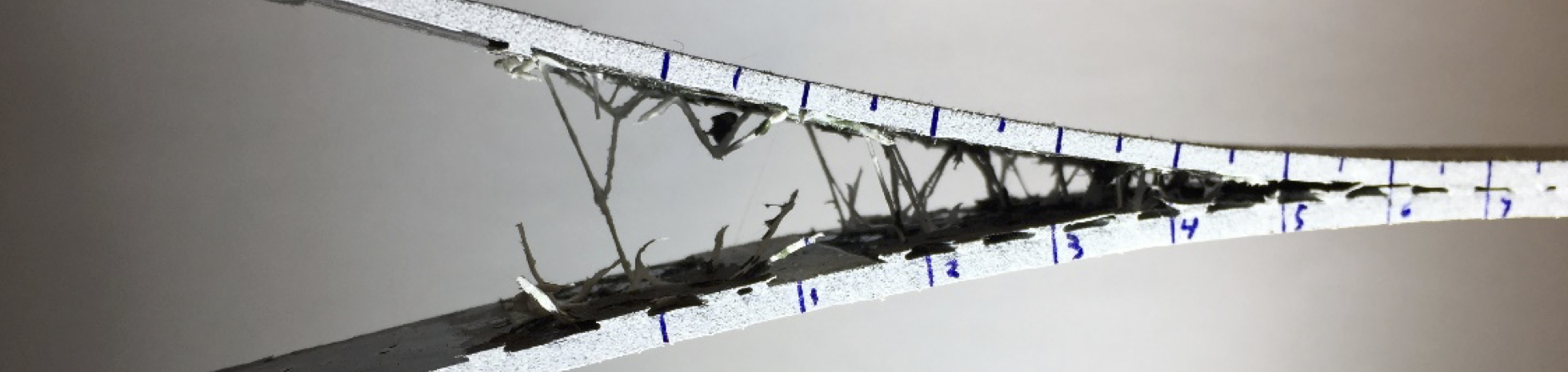
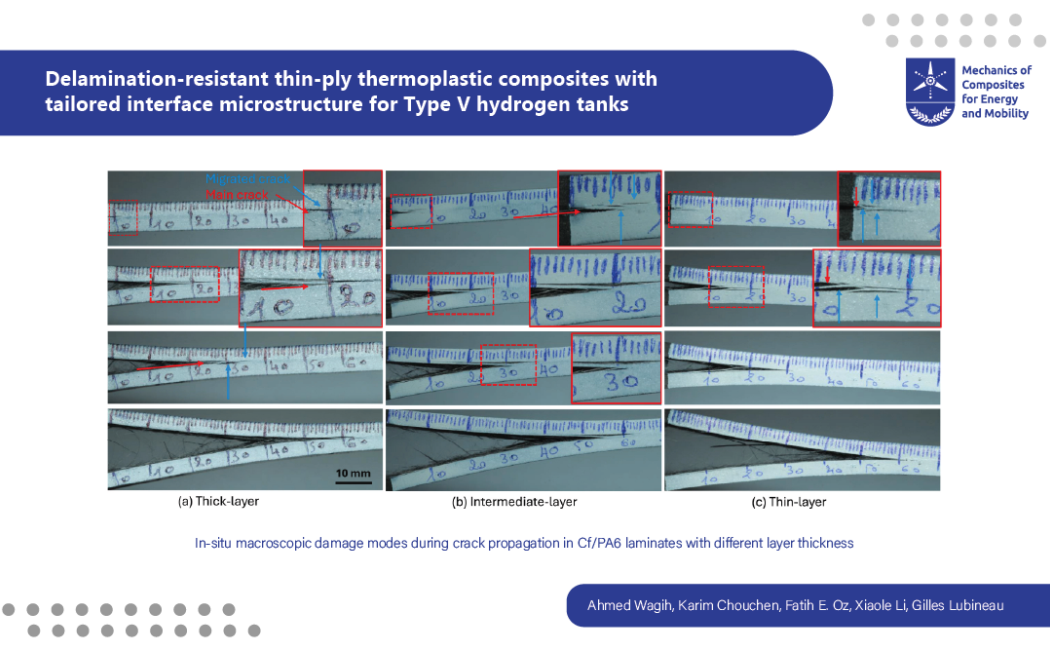
In this study, the effect of interface microstructure and loading rate on the mode-I fracture toughness of carbon fiber-reinforced polyamide 6 (CF/PA6) composites was investigated for understanding their role in preventing first-layer delamination in Type V hydrogen tanks during rapid gas decompression (RGD). The interface was tailored by varying layer thickness from 42 to, which intrinsically affected the interfacial crystallinity. Double cantilever beam tests were performed at strain rates of 1 and 100 mm/min, combined with in situ imaging and postmortem SEM analysis to assess the crack behavior. A 2D finite element model was developed to simulate strain distribution and ply bridging. The thin-layer laminate exhibited lower crystallinity (30.55 % compared to 33.56 % for thick-layer laminate), improved matrix plasticity, and higher fiber bridging, resulting in increased fracture toughness (from 4.9 N/mm for the thick-layer laminate to 7.3 N/mm for the thin-layer laminate). This laminate also demonstrated delayed crack initiation due to improved stress transfer and energy dissipation. At high strain rates, the scale of ply bridging reduced and matrix fracture behavior shifted toward shear band deformation, thereby reducing fracture toughness. Nevertheless, thin-layer laminates consistently maintained superior toughness over thicker ones, even under rapid loading; this highlights their resistance toward RGD delamination in Type V tanks.
https://doi.org/10.1016/j.ijhydene.2026.15543