
26 February, 2026
"Leveraging Processing-Induced Electromechanical Anisotropy of Laser-Induced Graphene for One-Shot Engraving of Highly Sensitive Strain Sensors"
Alaa M. Abdou, Hassan A. Mahmoud, Majed A. Alrefae, Yaping Zhang, Houssem Eddine Rekik, Aldyandra Hami Seno, Gilles Lubineau.
ACS Applied Nano Materials (2026)
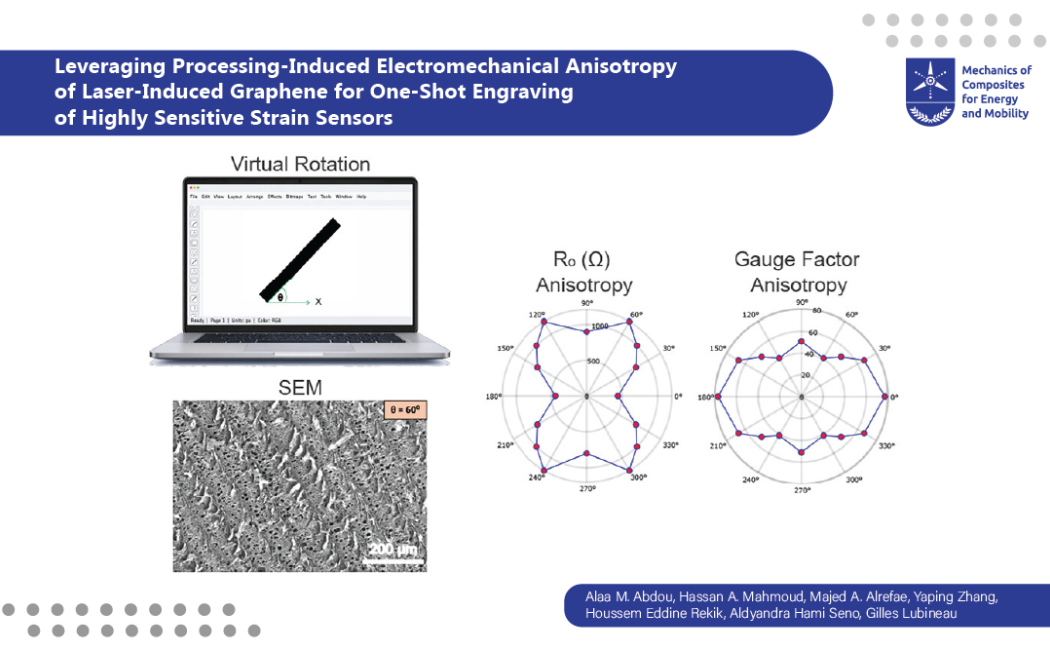
Laser-induced graphene (LIG) is a promising carbon nanomaterial owing to its straightforward and cost-effective fabrication. However, the laser rastering process results in highly anisotropic microstructures that influence the macroscopic response. This work systematically examines the electromechanical anisotropy of LIG on polyimide films produced by a CO2 laser by virtually rotating the object with a certain tilt angle in the design software before laser processing, while fixing the laser scan direction. This simple manipulation of the scan strategy induced varying fluence gradients across the sample, profoundly affecting the microstructure, conductivity, and sensitivity of LIG. Raman mapping analysis, coupled with principal component analysis and supported by scanning electron microscopy imaging, revealed notable differences in the graphitization degree and defect density of LIG tied to its scan strategy. A strong dependence of the LIG properties on the tilt angle was observed. The optimal configuration at a tilt angle of 0° yielded the highest gauge factor (GF) and lowest initial resistance. Anisotropy could be further tuned via laser power, with higher powers leading to increased anisotropy. Using optimized tilt angles, piezoresistive LIG strain sensors with GF 3–10 times higher than conventional constant-tilt configurations were manufactured. Applying the same concept to LIG fibers, their anisotropy was exploited to realize a transmission line-based capacitive strain sensor with a 10-fold increase in the GF in the low-strain region (0–1%) by optimizing the scan strategy. Thus, this study demonstrates that the scan strategy is a powerful and accessible tool for optimizing strain sensors and expanding their use in wearable electronics, structural health monitoring, and soft robotics.
https://pubs.acs.org/doi/10.1021/acsanm.5c0524